Designing a sustainability app that sustains behavior.
01
// OVERVIEW
Sustainability Apps Track Behavior.
But rarely change behavior.
Plantifact was designed to test whether visible progress, ownership, and structured reinforcement could meaningfully improve retention.
Plantifact is a mobile sustainability app where users log eco-friendly actions such as recycling, conserving water, or using public transit. Each action contributes to the growth of a personalized virtual garden.
The Core Hypothesis
If sustainable behaviors produce immediate, visible, and emotionally meaningful feedback, users are more likely to remain consistent.
Project Details
DURATION
5 Weeks
TEAM
4 Designers
PROJECT TYPE
Academic Project
ROLE
Behavioral strategy, feature prioritization, interaction design, usability testing, accessibility validation
02
// THE PROBLEM
THE RETENTION PROBLEM
WHY SUSTAINABILITY APPS LOSE USERS?
Initial problem framing revealed a consistent pattern:
Users begin with strong intent
Logging feels repetitive
No visible long-term progression
Motivation decays
Most apps emphasize tracking.
Few design for reinforcement.
DESIGN QUESTION
How might we design a system that reinforces eco-habits instead of merely recording them?
03
// THE MOTIVATION SYSTEM
DESIGNING FOR LONG-TERM MOTIVATION
THE PRODUCT ARCHITECTURE SUPPORTS A BEHAVIORAL LOOP:
Rather than layering features onto a habit tracker, I structured the experience around a reinforcement system.
FOUR CORE REINFORCEMENT PILLARS
VISIBLE PROGRESS
Reinforcement Mechanism: Momentum Visibility
What makes progress visible
Streak continuity
Level advancement
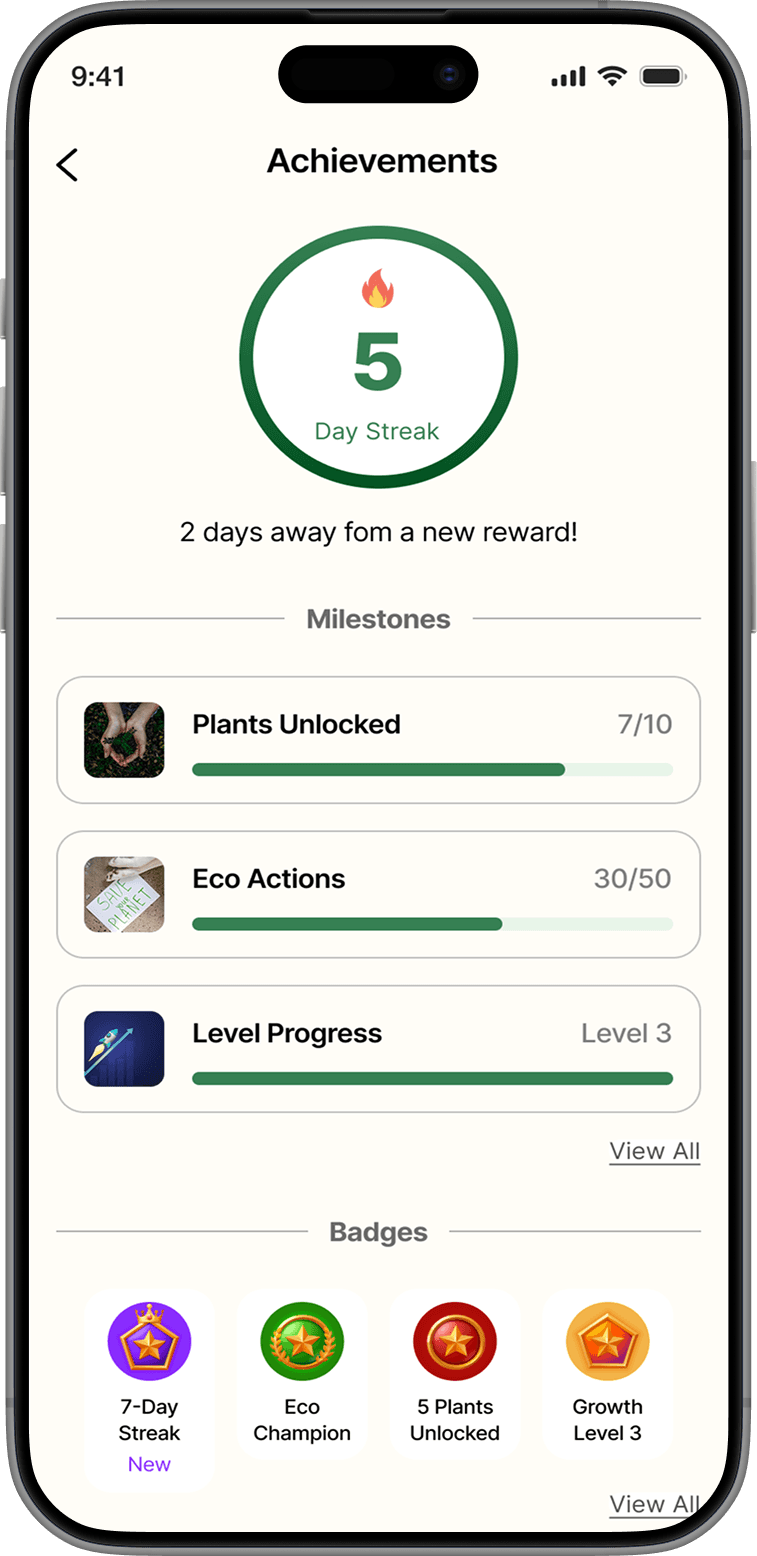
Milestone recognition
Growth visualization
Progress is not abstract. It is visual and cumulative.

Progress must feel cumulative.
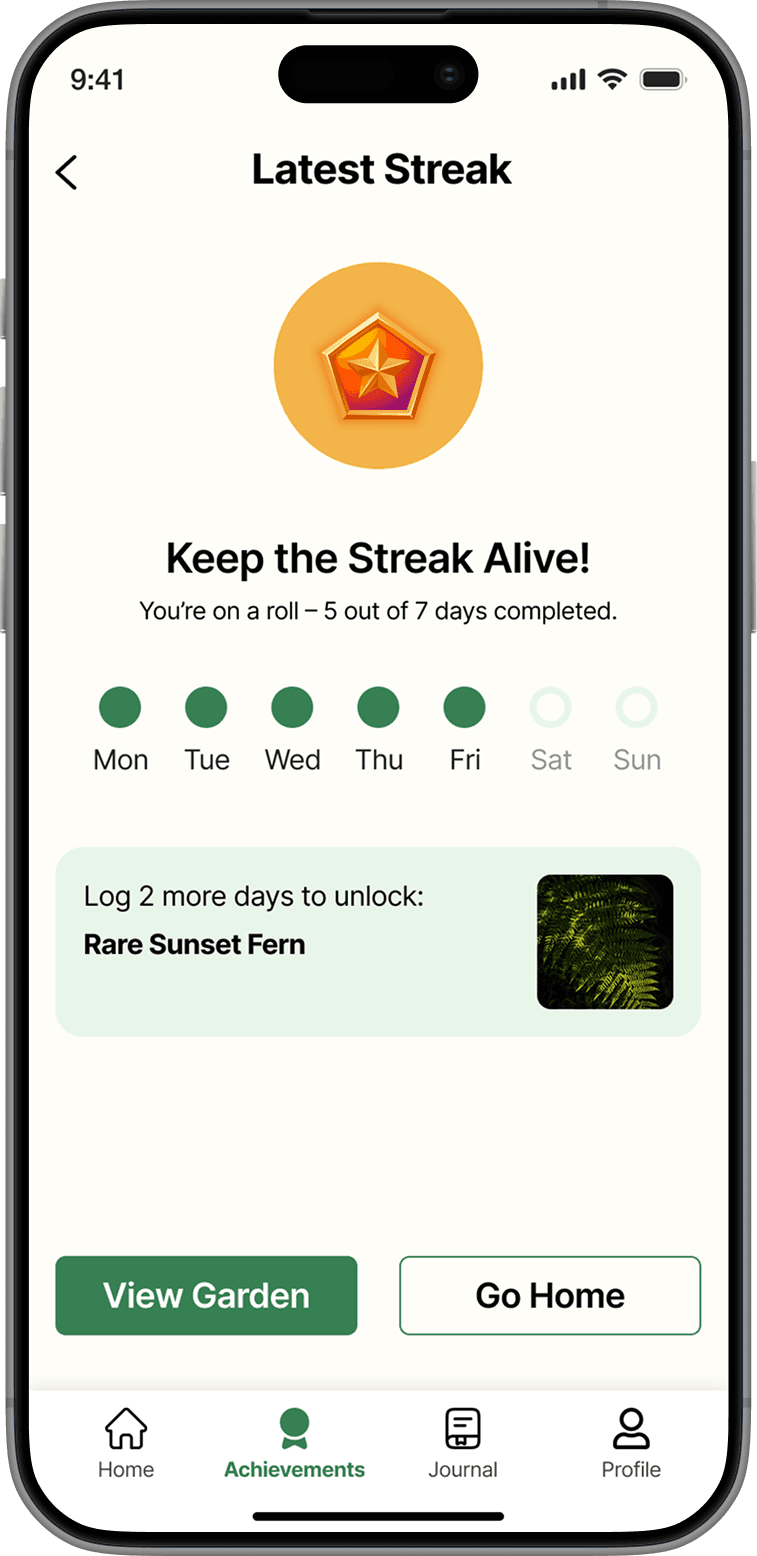
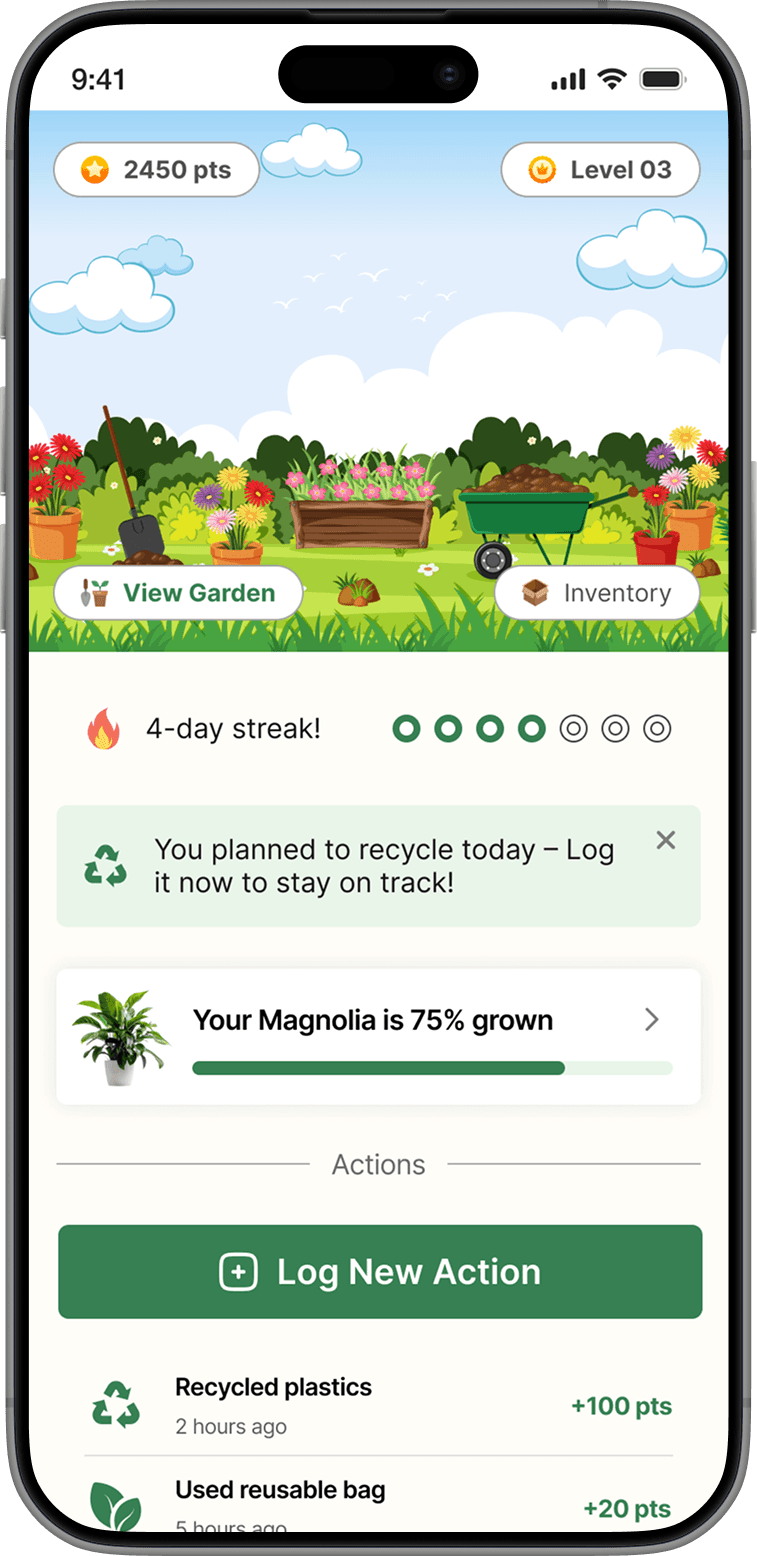
Streaks and level indicators convert isolated actions into visible momentum.
Streak visibility reduces habit drop-off.
The streak bar and recycling reminder subtly nudge users to avoid breaking their habit.
OWNERSHIP
Reinforcement Mechanism: Emotional Investment
Behavior must leave a mark.
Plantifact transforms logged actions into environmental change, creating a space users feel responsible for.
Personal investment strengthens habit durability.

AGENCY INCREASES ATTACHMENT.
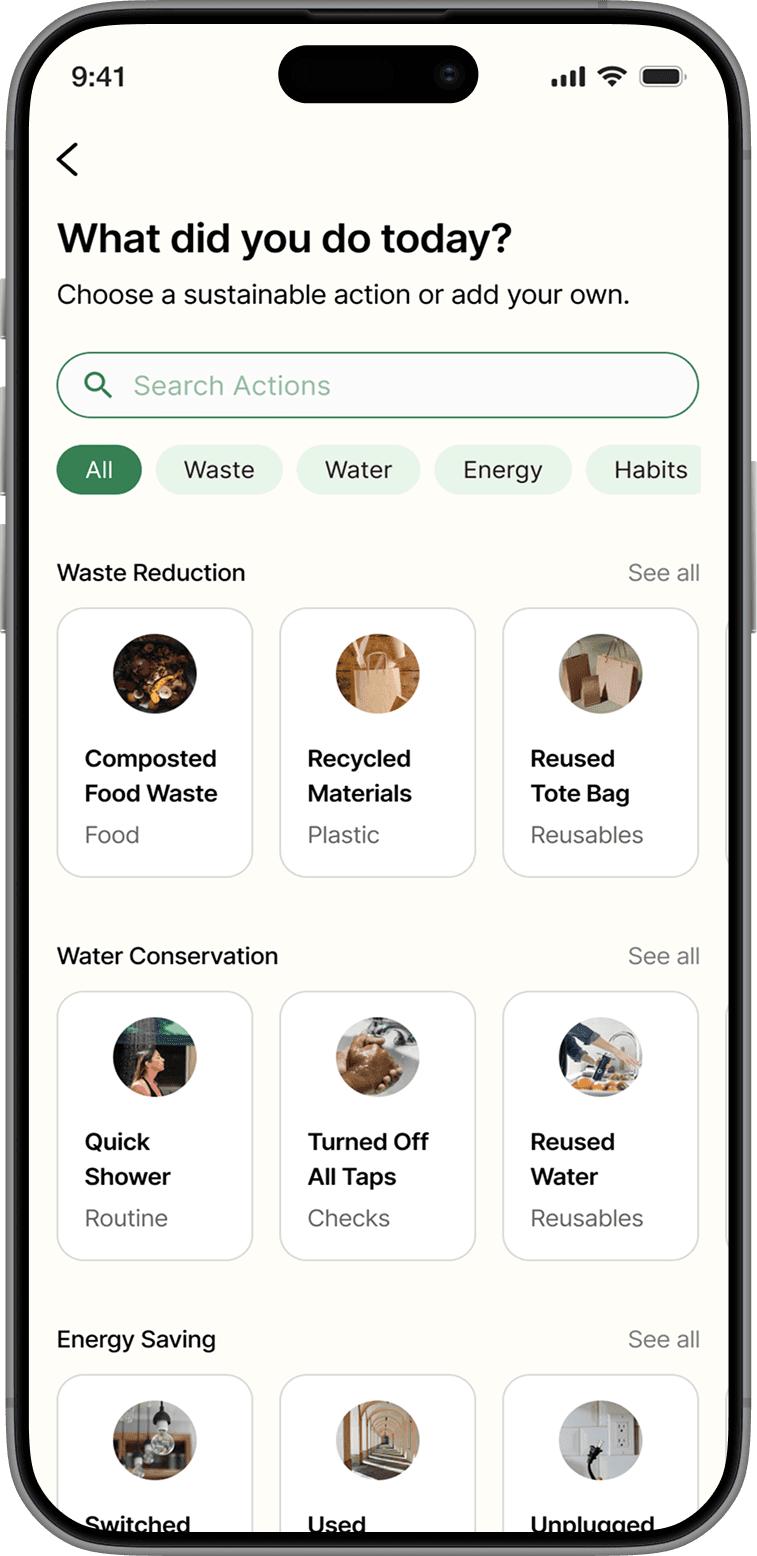
Allowing users to rearrange and curate their garden transforms the system from tracker to personal space.
THE ENVIRONMENT MIRRORS BEHAVIOR.
Every eco-action results in visible spatial change, reinforcing accountability through ownership.
IMMEDIATE FEEDBACK
Reinforcement Mechanism: Response Certainty
Every action triggers immediate system response:
Point allocation
Growth animation
Progress advancement
Progress is not abstract. It is visual and cumulative.
Momentum must feel interruptible.
High-value unlocks are intentionally placed near cycle completion to reduce drop-off before habit stabilization.
State visibility reduces ambiguity.
Clear daily indicators eliminate uncertainty and reinforce loop continuity.
ANTICIPATION
Reinforcement Mechanism: Future-Oriented Motivation
Future value drives present action.
Locked biomes, milestone rewards, and visible proximity to unlocks create forward pull beyond daily streak completion.
Anticipation extends the reinforcement loop beyond daily completion.
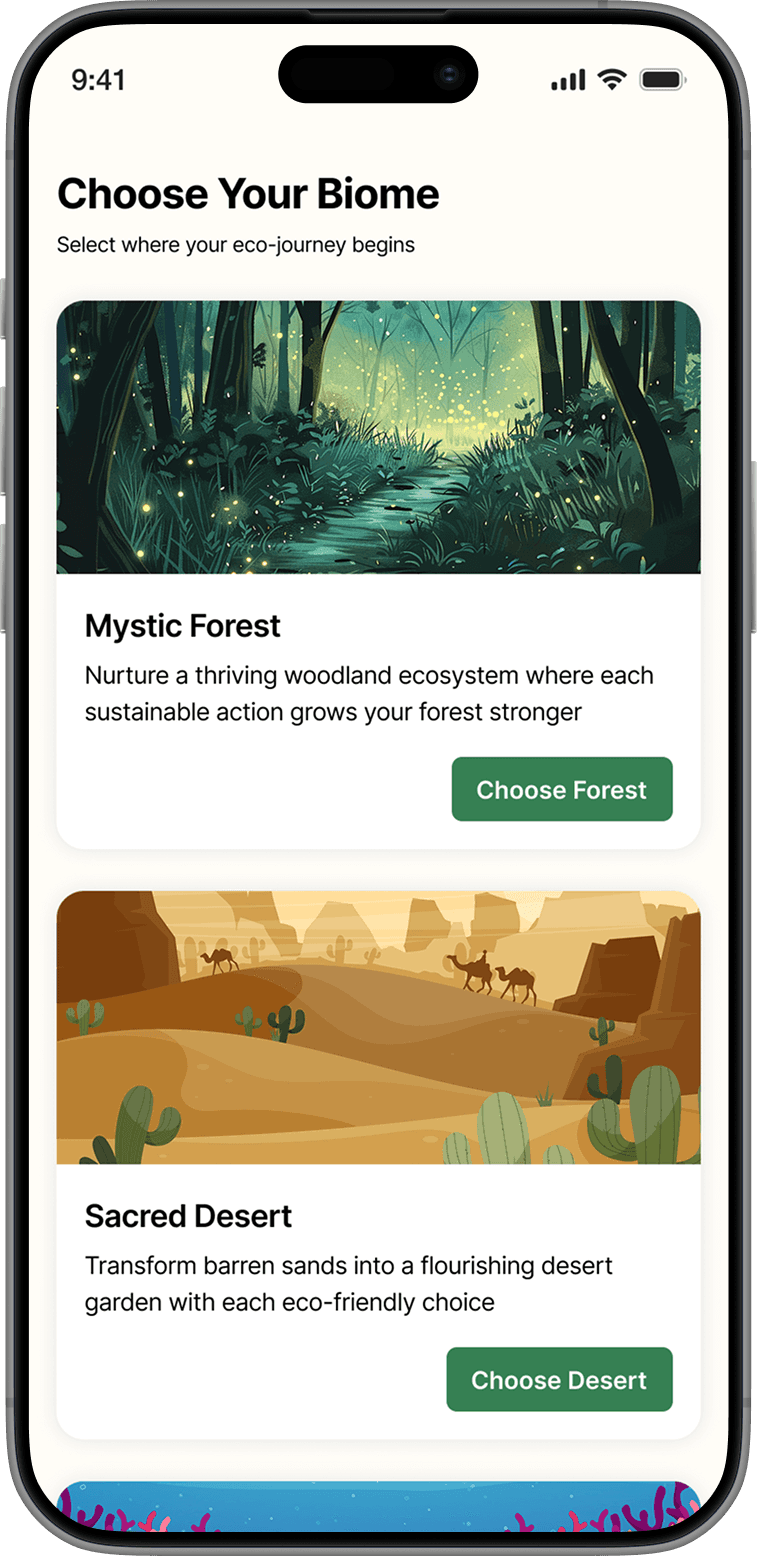
Choice increases commitment.
Selecting an ecosystem establishes identity early in the experience.
Future states sustain engagement.
Locked environments signal growth potential, encouraging continued participation to unlock visual expansion.
Proximity amplifies motivation.
Showing users how close they are to a reward transforms streak maintenance into a short-term objective.
04
// core mvp decision
FROM 20+ IDEAS TO A FOCUSED MVP
Scope Reduction to Preserve Behavioral Clarity
Generated 23 feature concepts during early ideation.
To avoid feature dilution, I structured prioritization using an Impact vs Effort matrix.
The goal was clarity, not feature density.
Core MVP Decisions
SELECTED
Eco-action Logging
Garden Growth System
Streak Tracking
Milestone Achievements
Inventory & Customization
EXCLUDED
Social Comparison Leaderboards
Complex Analytics Dashboards
Penalty-based Mechanics
Heavy Notification Systems
Design Decisions & Strategic Omissions
05
// USER TESTING
VALIDATION & ANALYSIS
Testing the system, not just screens
Task-based usability testing, SEQ scoring, and a pre-post survey were used to validate the reinforcement system, not just the interface.
Participants
Tasks Measured VIA SEQ
Average SEQ score across primary tasks
AVERAGE SEQ SCORE PER TASK (7-POINT SCALE)
6.4
T1
6.1
T2
5.6
T3
5.4
T4
6.0
T5
6.3
T6
6.5
T7
6.7
T8
6.8
T9
6.9
T10
Most tasks scored above 6 on a 7 scale in perceived ease.
Lower scores on T3–T4 revealed ambiguity in custom eco-action logging and garden editing confirmation states.
ITERATION OUTCOME
BEHAVIORAL IMPACT ( PRE → POST )
↓ Lower scores are better for difficulty metrics
Pre-post study results indicated:
Increased confidence in sustainable tracking
Reduced perceived difficulty in remembering eco-actions
Higher intention to log daily
This suggests reinforcement mechanics influenced user motivation, not just usability.
ACCESSIBILITY VALIDATION
Accessibility was treated as a design requirement, not a compliance checklist. WCAG AA & AAA contrast compliance. Color blindness simulations: Protanopia, Deuteranopia, Tritanopia.
06
// REFLECTION
PRODUCT INSIGHT & FORWARD STRATEGY